DARK CORNER COMMUTE (Emrys Journal, Vol. 33, Spring 2016)
My daily commute from north Greenville County to Spartanburg parallels the Southern edge of the Appalachian Mountains, slicing through ecologies both human and nonhuman. I begin in the “dark corner” of upstate South Carolina on Chinquapin Road, a country road that winds through a foothills forest where the weeds grow flush to the edge of the blacktop as if they will devour it. In late August, the heavy stalks of tall Joe Pye weeds nod their purple blossoms over the road’s dips and curves. The unpaved driveways that emerge here and there from the foliage hint at the few homes that lie concealed in the woods. Occasionally, another sign of human habitation appears— motley groups of tentative dogs in various shapes and sizes wander onto the road to regard my car impassively. When I do catch a glimpse of a human habitation amidst the trees, the focal point of the yard is a makeshift decoy deer rigged as a target for hunting practice.
Emerging from this narrow forest road, I turn onto Cherokee Foothills Scenic Highway. The road becomes straight and leads through farms, at first widely spaced and edged by woods, but then becoming more densely packed without forests to separate the fields. To my left, the mountains form a backdrop against which roam horses of assorted colors. To my right, a herd of white cows grazes the hills’ undulations, not realizing they ride the last waves of the ancient Appalachians as the landscape billows like a sheet thrown up into the breeze before calmly leveling out in its descent to the coastal plain of the low country.
Heading away from the mountains, I turn right onto New Cut Road, a less travelled byway that cuts deeper into the farmlands. The low rising sun steams the silver dew from night-fogged fields. My passing car startles flocks of birds from their perches on pasture fences and they swoop dangerously low across the road just barely missing my windshield. Many mornings they are blackbirds, but sometimes they are something less monochrome, something I should know the name of but don’t. In the center of one farmer’s field stands a lone, massive tree with low, crooked branches spreading dense and wide. It looks regal in the morning light with the surrounding grasses rising only a minute fraction of its height. I find myself wondering how many generations have deferred to this tree by plowing around it.
I don’t know the names of the crops I drive past. How many travelers who pass through here do? Some fields are full of delicate grasses that, taken individually, might not seem to have much color, but when viewed together in a field present a gossamer sea of floating violet, muted like a Monet in the light of early autumn. In another field, thick, sturdy plants of deep green stand in rows. As they mature into autumn, each plant is topped with a tufted finial of dirty bronze— the seeds perhaps? Yet another field of plants turns a surprising shade of vibrant yellow as the summer wanes. The smooth, densely packed gold leaves remind me of a yellow brick road. These three fields are mysteries to me. They represent whole worlds I cannot name and will only experience from behind a glass pane as I drive past.
As I come closer to the city of Spartanburg, the fields and forests are interrupted occasionally by new cookie-cutter housing developments cropping up out of the farmland. These developments are uniformly unimaginative. Doubtless, the houses in them were mass-produced expediently for maximum profit. They stand on small, square lots, with token lawns, mostly devoid of trees, shrubs, or gardens.
These newer developments presage the transition to the city limits, a transition that is abrupt. As I pull through an intersection, I know immediately that I’ve entered a distinctly different type of space. On one side of the intersection, only fields; on the other, a Dollar General store and the beginning of a crowded residential neighborhood with small, older homes. Somewhere in the middle of the intersection, I’ve crossed an invisible line. From here on, the houses are more densely packed and interspersed with businesses— in this section of town, chiefly factories and the occasional gas station. This isn’t the side of town the city showcases in its brochures. Sometimes, as I drive through it, I notice an unrecognizable stench permeating the air, possibly from a factory. This landscape cluttered with homes and businesses contains no large, stately trees of the kind that grace the neighboring farm fields— trees that may have witnessed several generations of families tend those very same fields. There is no continuity, no salience, no natural comfort in the housing developments and urban areas. Immediately, I miss the forests and farmlands.
It’s strange I should feel any nostalgia for farms. I did not grow up on a farm, nor did my parents. Farming is not in my family. But good friends of ours owned a farm that had been in their family for generations and I spent many weekends there. I discovered what a warm hiding place can be made from tightly packed bales of hay. I also found out that contrary to popular belief, not all sheep in a flock are the same. And I learned that America has a native chestnut tree, producing both edible nuts suitable for roasting and low-sprawling limbs ideal for climbing. In addition to exploring the farm as a child, I also spent countless hours playing in the woods near my home. Sitting alone in a forest, I learned the various textures and colors of mosses, what insects lurked under leaf litter, and what birdsong against silence sounds like. Are these lessons trivial? I cannot measure them, but even now, they anchor me in some indescribable way.
It was only after I went to college and moved away from the farmlands and forests that I realized, as shadowy and elusive as it may sound, these are things that feed the soul. A cookie-cutter housing development does not do that. The Dollar General does not do that, nor does a factory or gas station. Why? Perhaps because the urban landscape lacks ecological continuity, whereas forests and farms force a confrontation with one’s reliance on nature for survival. On a farm or in a forest, the circle of life is closed in a way it cannot be at the grocery store. In the realization of this circle, we find completeness. We find meaning.
As landscapes become increasingly urban and suburban, we lose salience— our intrinsic connection to the natural landscape that surrounds us. We lose the ineffable, and since it is ineffable, how will we tell our children what has been lost?
LESSON FROM AN UNLIKELY FRIEND (NC Piedmont Wildlife Center Essay Contest Winning Entry, 2012)
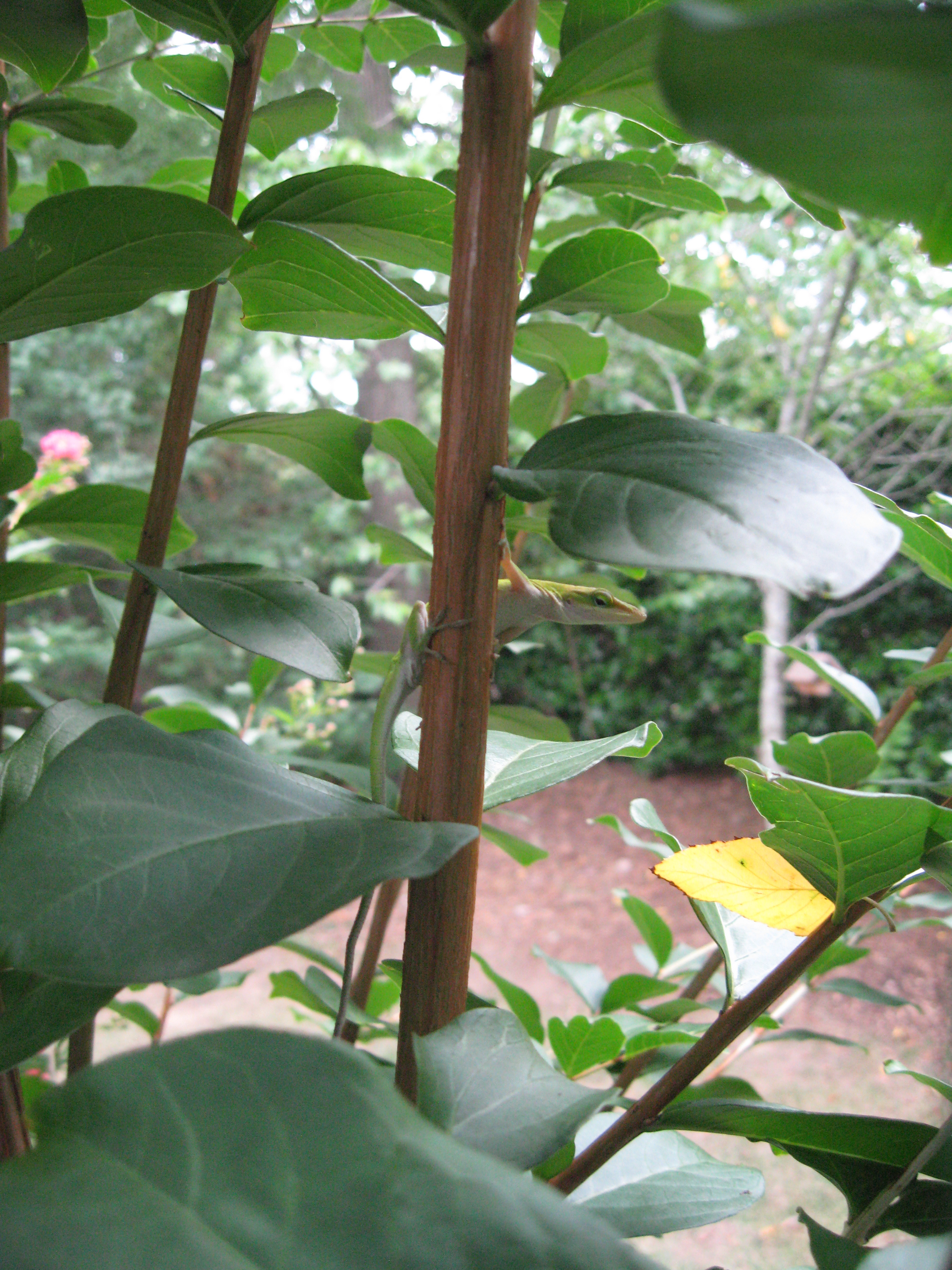
I was sitting on my deck at an umbrella table one warm spring day in Cary, NC when something suddenly dropped from the top of the umbrella onto the seat of the chair next to me with an abrupt “thwack!” I was so startled that I threw down the book I was reading, jumped up, and quickly moved away from the chair only to realize that I was fleeing from a small lizard! The slender little lizard was about six inches long and lovely pale green in color. The lizard stood on the seat of the chair and faced me seemingly unafraid. It was clear that he or she was examining me. Perhaps the lizard had been observing me for a while from the top of the umbrella and had decided to come down for a closer look. As we stood there looking at each other, the lizard extended and retracted a bright pink dewlap from the underside of its neck, perhaps as a territorial display. After we had sized each other up for a few minutes, I sat back down on my chair and continued reading my book. To my surprise, the lizard remained on the chair next to me for quite a while. He or she seemed to have accepted me as a natural part of the environment and was content to sit next to me in the sun.
Fascinated by this encounter, I did a quick Google search and found that the lizard was a “Carolina anole” (Anolis carolinensis), also known as a “green anole.” I learned that the bright pink dewlap meant that the lizard on my deck was a male of the species. The same lizard visited me many times after that initial encounter and I soon learned that he lived in the crape myrtle trees surrounding the deck. Remarkably, I noticed that the lizard had the ability to change color to match his surroundings, so that he became grayish-brown to match the color of the boards when he sunned himself on the deck. When the lizard was in a crape myrtle tree, he took on a soft green color to match the leaves, while his pink dewlap happened to be the exact color of the tree’s pink flowers. Sitting motionless on a limb amongst the foliage, the lizard truly looked like an extension of the tree!
I came to think of the lizard as a friend and I looked forward to seeing him every day. He seemed as curious about me as I was about him. I often noticed the lizard observing my outdoor activities. He was not afraid to come within a few feet of me to get a better look at whatever I was doing. The human behavior that my lizard most enjoyed observing was the watering of the plants. Whenever I watered the various potted plants that I kept on the deck, my lizard would perch on the deck rail for a birds-eye view of the event. He would travel along the rail, following me around the perimeter of the deck and stopping at each plant to watch me water it. The lizard turned the tables on me as he took up the hobby of human-watching in the same way that some people enjoy bird-watching! The little anole lizard was challenging my anthropocentric worldview.
One day I observed my lizard chasing another similar lizard. The two lizards seemed playful rather than aggressive and I wondered if it might be a courtship behavior. Sure enough, a few weeks later, I was watering a potted geranium when I noticed something quickly scurrying to hide among the plant’s leaves. It turned out to be the tiniest lizard I had ever seen! The young lizard was so small that its entire body from the tip of its nose to the tip of its tail fit perfectly on a geranium leaf. I felt sure that this tiny lizard must be the offspring of my own lizard. Knowing that a family of anole lizards had made a home on my deck and in my plants, I became hyper-vigilant about what types of chemicals I used in the area. I did not want to use any pesticides or other products that might interfere with the health of the anoles. I wanted my backyard to be a healthy environment for both humans and lizards.
My friendship with the anole lizard made me think of my backyard in a new way, from the perspective of the often-ignored creatures that make their home right beside me. My lizard serves as a reminder that we do not need to go very far to experience the natural world. If we are observant and open to the possibilities, we can form rewarding relationships with the creatures in our own backyards. Greater attention to the natural world, even at the seemingly insignificant level of observing a single lizard, can profoundly change the way we view our relationship to the environment. This, in turn, can lead to sounder ecological practices that make the environment a better place for animals, plants, and humans alike. And as my anole lizard taught me, it is just plain fun to count members of other species among one’s friends!
 Jill A. Coyle